

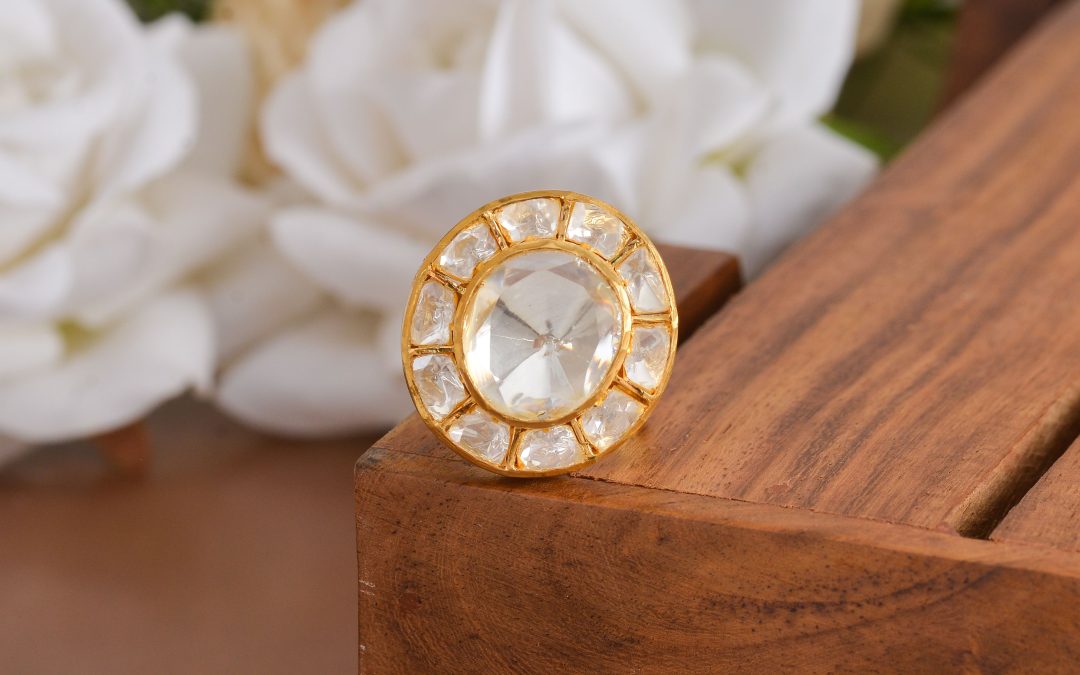
Diamonds should not routinely fall out of a well-made, properly maintained ring, and there is no normal number of years after which you should expect one to come loose. A secure center diamond can stay in its setting for decades. What usually changes is the metal around it: prongs become thinner, tiny pavé beads wear down, a ring takes an impact, or the setting gradually changes shape.
At Beard Fine Jewelers in Lufkin, the reassuring part is that we can often see those changes before the diamond is lost.
You may place the ring on the counter because it has started catching your sweater, because one small stone disappeared, or simply because something suddenly feels different.
We turn it over, look closely, and start there.
Can a Diamond Fall Out Without Feeling Loose?
Yes.
This surprises people because it seems logical that a loose diamond should move first.
But imagine a four-prong engagement ring.
Three prongs may still be holding the center diamond firmly while the fourth has become very thin or lifted slightly away from the stone.
From the top, everything can look normal.
The diamond may not rattle at all.
Under magnification, however, we can see that much of the security is now coming from the remaining prongs.
That is why waiting until you can physically move the diamond is not a particularly good test.
What We Notice First
We compare the prongs with one another.
A single prong that is shorter, flatter, thinner, or sitting farther from the diamond can tell us much more than whether the stone moves today.
Why Is My Ring Suddenly Snagging on Clothing?
This is one of the questions we pay close attention to.
If your ring has always caught occasionally because of its design, that may simply be part of the setting.
If it suddenly starts pulling threads from sweaters, towels, or hair, we want to see it.
A prong may have lifted.
Imagine sliding a very fine hook underneath a thread. That is essentially what a raised prong can begin doing.
We can usually show you the difference under magnification: three prongs sit smoothly against the diamond, while one has developed a small gap.
At that point, continuing to wear the ring can allow the prong to move farther away.
The snag is not just an annoyance. Sometimes it is the ring giving you an early warning.
Do Small Diamonds Fall Out More Often?
Small accent diamonds can be more vulnerable simply because of how delicately they must be set.
A center diamond may be held by four or six substantial prongs.
Now look at a pavé band.
Those tiny diamonds may be secured by very small beads or miniature prongs so that you see maximum sparkle and very little metal.
The effect is beautiful.
The construction is also finer.
A knock that does very little to a substantial solitaire prong may affect a tiny pavé bead differently.
There is another factor: quantity. A ring with 30 small diamonds simply has many more individual setting points than a solitaire with one center stone.
That does not mean pavé is unreliable. It means there are more small areas to monitor.
Does One Missing Stone Mean the Others Are at Risk?
Not necessarily—but we would inspect the neighboring stones before replacing anything.
Sometimes one diamond is lost because that particular area took an impact.
The metal around the other stones may be perfectly healthy.
Other times, we look at the empty seat and then move along the band and see the same pattern repeated: flattened beads, worn prongs, or a channel edge that has become thinner throughout the ring.
Now the missing diamond is giving us information about the rest of the setting.
That changes the repair.
Instead of simply replacing one stone, we may recommend securing other vulnerable areas at the same time.
From the Jeweler’s Bench
When one small stone is missing, the empty space is only part of what we examine.
The surrounding metal often tells us why it came out.
Can an Eternity Band Lose Stones More Easily Than a Solitaire?
An eternity band has diamonds continuing all the way around the finger.
That creates beautiful uninterrupted sparkle, but it also means some of those diamonds spend their lives on the underside of your hand.
Think about where your palm rests on a desk, countertop, steering wheel, gym equipment, or shopping cart handle.
The bottom of the ring encounters far more contact than the top.
A solitaire typically keeps its primary diamond on top of the finger, while the underside is mostly metal.
An eternity band places settings and diamonds around the entire circumference.
That does not make an eternity band a poor choice.
It simply means its construction and maintenance deserve attention—especially if you wear it every day.
Can Resizing Make Diamonds Loose?
It can, depending on the design and how much the ring is resized.
When a ring is made larger or smaller, its circular shape is being altered.
On a simple solitaire, that adjustment may be relatively straightforward.
On a pavé or eternity-style ring, diamonds and settings may extend much farther around the shank.
Changing the ring’s curvature can change how those small stones sit in their seats.
That is why resizing is not just about reaching the correct finger size.
After the work, the stones should be checked again.
If you bring us a diamond band for sizing, we are looking at the construction of the entire ring—not simply the portion that needs adjustment.
Can Heat, Cold, or Seasonal Changes Make a Diamond Loose?
Seasonal temperature changes do not normally loosen a properly set diamond by themselves.
What changes more noticeably is your finger.
Here in East Texas, warm weather can make fingers swell, while cooler weather may make a ring feel looser.
That can create a different problem.
If your ring becomes very loose, it may rotate more often or strike surfaces in ways it normally would not.
So the seasonal issue is usually about fit and wear, not the diamond expanding or contracting enough to escape its setting.
If your ring spins constantly during cooler months or becomes uncomfortably tight in the heat, we can look at fit before assuming the setting itself is failing.
Can a Missing Small Diamond Be Matched Closely to the Others?
Usually, yes.
This is where replacing a stone becomes much more visual than simply ordering the correct diameter.
We look at the surrounding diamonds.
- How bright are they?
- What approximate color are they?
- How are they cut?
- How large is the opening?
A replacement that is technically the correct size can still stand out if it looks noticeably whiter, darker, or different from the neighboring stones.
With pavé and anniversary bands, our goal is usually for your eye to travel across the ring without stopping at the replacement.
If we have done that well, the new stone should settle naturally into the pattern.
Does Ring Insurance Cover a Diamond That Falls Out?
Sometimes, but coverage depends entirely on your insurance policy.
A jewelry policy may cover accidental loss or damage, while another policy may contain different conditions, deductibles, or exclusions.
If a significant center diamond is lost, document what happened and contact your insurer before making assumptions about coverage.
It is also helpful to keep current appraisals, photographs, grading reports, and purchase documentation.
At Beard Fine Jewelers, appraisals are part of the broader conversation around protecting fine jewelry because a beautiful ring should also be properly documented.
How Often Should You Have a Diamond Ring Checked?
For a ring you wear every day, an inspection about every six to 12 months is a sensible rhythm.
But we would not wait for the calendar if something changes.
Bring the ring in if:
- It begins snagging unexpectedly.
- You hear a click or rattle.
- A stone appears tilted.
- A prong looks different.
- The ring takes a hard impact.
- One small diamond is already missing.
Most of the time, putting the ring under magnification ends with a reassuring answer.
Sometimes we find one small area worth correcting.
That is exactly when we want to find it.
Our View at Beard Fine Jewelers
After more than 40 years in fine jewelry, we have learned that a missing diamond often begins with a very small change.
A snag.
A flattened prong.
A tiny gap.
One missing pavé stone.
A ring that suddenly rotates differently on your hand.
Those details may seem insignificant until we place the ring under magnification and show you what is happening.
Diamonds falling from rings are not simply an unavoidable part of owning fine jewelry.
Settings wear. Rings get bumped. Delicate metalwork changes with years of use.
But many of those changes can be seen and addressed while every diamond is still exactly where it belongs.
If something about your ring looks or feels different, bring it to Beard Fine Jewelers in Lufkin. We can examine the center diamond, accent stones, prongs, and overall setting with you—and show you exactly what we see before deciding whether anything needs attention.
Beard Fine Jewelers
2002 S 1st St
Lufkin, TX 75901
(936) 637-2848
www.beardfinejewelers.com