

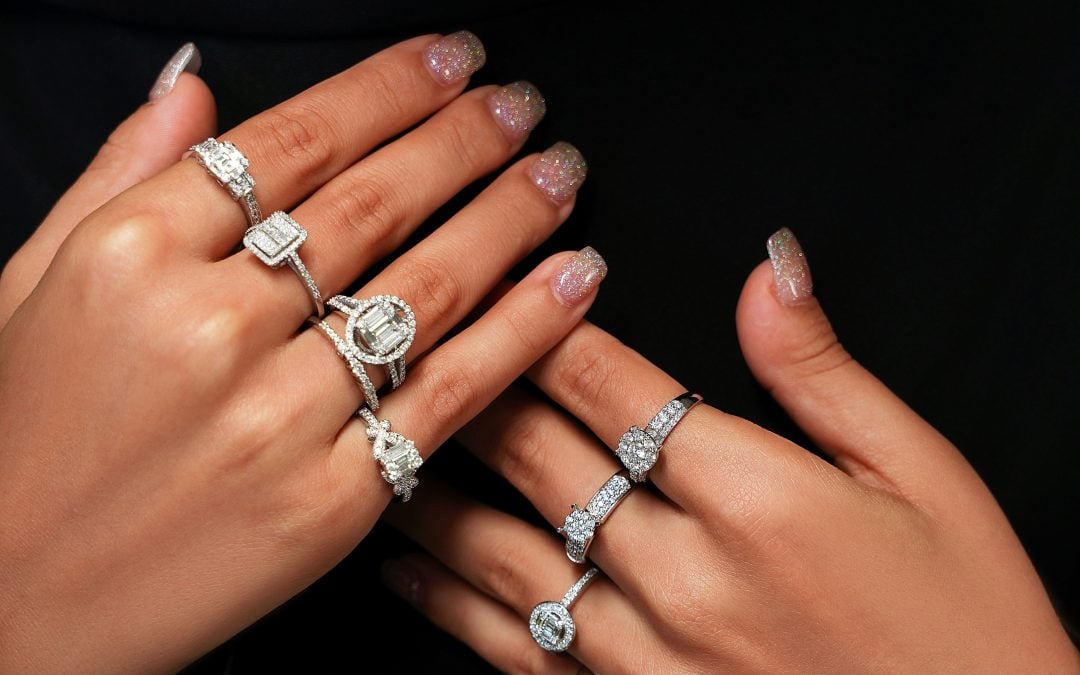
A diamond ring can absolutely get scratched, although the diamond and the metal around it behave very differently. Diamonds are extremely resistant to scratching, but the gold or platinum setting will naturally pick up fine marks through everyday wear. A diamond itself is much harder to scratch, though another diamond can scratch it.
At Beard Fine Jewelers in Lufkin, this distinction is usually where the conversation becomes more useful. A faint line across the bottom of your band, a cloudy-looking center stone, and a mark near the edge of a diamond are three different situations. One may be normal wear, another may simply need cleaning, and another deserves a closer inspection.
Before trying to polish anything yourself, it helps to know exactly which part of the ring has changed.
“The Bottom Of My Ring Is Covered In Tiny Lines. Is That Normal?”
Very normal.
The underside of an engagement ring or wedding band is usually the first area to show wear because it constantly touches desks, countertops, steering wheels, door handles, and whatever else your hands meet during the day.
Gold and platinum are durable jewelry metals, but neither is scratch-proof.
Those fine surface marks often blend over time into what jewelers call a patina—the subtle evidence that the ring is actually being worn.
If the scratches are superficial, they usually do not affect the structure of the ring at all.
The question becomes whether you like that lived-in finish or prefer the cleaner look of a freshly polished band.
Can The Diamond Itself Actually Be Scratched?
It is possible, but unusual in ordinary wear.
Diamond ranks 10 on the Mohs hardness scale, which means very few materials can scratch its surface. Another diamond, however, can.
That becomes relevant in a jewelry box.
If two diamond rings are tossed together, the exposed edge of one diamond may rub against another stone or against a neighboring piece.
Care Tip: Store diamond jewelry so the stones do not rest directly against other jewelry. A soft individual pouch or separated compartment protects both the diamonds and the metal settings around them.
“My Diamond Looks Scratched, But I Cannot Feel Anything.”
It may not be a scratch at all.
We often want to clean the stone before making that call.
Diamonds attract oils easily, and residue from lotion, soap, sunscreen, or everyday handling can leave streaks or cloudy areas that look surprisingly similar to surface damage.
A small inclusion you had never noticed can also suddenly catch your attention once you start looking closely.
If the mark remains after a professional cleaning, then we would examine it under magnification.
That is much safer than trying to scrub, buff, or polish the diamond yourself.
What If The Mark Is Near The Edge Of The Diamond?
That gets our attention more quickly.
What looks like a scratch near the girdle—the outer edge of the diamond—could actually be a small chip.
Diamonds resist scratching extremely well, but they can chip if struck at a vulnerable point.
This matters especially with shapes that have corners or tips, such as pear, marquise, princess, and emerald-cut diamonds.
If you notice a new mark after hitting the ring, bring it in before continuing to wear it regularly.
What We Notice First: The Stone Or The Setting?
Often, the setting.
If a ring has taken a hard hit, the diamond may be completely fine while a prong has shifted, the head has tilted, or a small side stone has loosened.
That is why we do not look only at the mark you noticed.
We look at what happened around it.
A scratch tells us where to start. The rest of the ring tells us whether anything actually needs repair.
Do Pavé And Side-Stone Rings Show Wear Differently?
Yes.
A solitaire gives you relatively little metal around the center diamond. A pavé ring has many small diamonds held by very small amounts of metal.
Over time, those tiny surfaces can show wear too.
The issue is not that the diamonds themselves become scratched easily. It is that the metal holding them can gradually wear, flatten, or pick up marks.
If your ring has pavé down the shoulders, regular inspections become more important because there are more individual settings to check.
This is also why aggressive home polishing is a bad idea. Removing metal from a delicate pavé area is very different from gently refinishing a plain band.
Can Two Rings Scratch Each Other?
Definitely—and this is one of the most overlooked sources of wear.
An engagement ring and wedding band can rub against each other thousands of times during normal wear.
If a diamond girdle or pavé edge touches the neighboring ring, the harder diamond can gradually wear into the softer metal.
The damage may begin as a small groove that you barely notice.
That is why we pay attention to how rings sit together, not just how they look from above.
| What You See | What May Be Happening | What We Would Check |
| Fine marks under the band | Normal surface wear | Metal condition |
| Groove between two rings | Rings rubbing together | Alignment and contact points |
| Cloudy diamond | Oil or residue | Professional cleaning |
| Mark near diamond edge | Possible chip or abrasion | Stone under magnification |
| Scratches around pavé | Wear to small metal settings | Stone security |
| Deep dent in band | Impact, not simple scratching | Structural integrity |
Should You Polish Every Scratch Out?
Not necessarily.
Polishing removes a very small amount of metal to restore a smoother surface. Done professionally and occasionally, it can refresh a ring beautifully.
But repeatedly polishing away every tiny mark is not something we recommend.
A ring that is worn every day is going to pick up new surface wear again.
If the scratches are cosmetic and you barely notice them, leaving them alone is perfectly reasonable.
We would save refinishing for when the ring genuinely looks tired, needs repair work, or you simply want it refreshed for an important occasion.
Does White Gold Need Different Attention?
Yes, because many white gold rings receive a rhodium finish to create their bright white appearance.
Over time, normal wear can make that finish look thinner in certain areas, particularly underneath the finger.
Sometimes what a client thinks is scratching is actually the underlying metal tone becoming more visible as the rhodium wears.
In that case, polishing alone is not necessarily the complete answer. The ring may benefit from refinishing and re-rhodium plating.
Yellow and rose gold do not have that same issue, although they still develop normal surface scratches.
Platinum develops its own softer-looking patina, which some clients love and others periodically have refinished.
“Can I Choose A Ring Design That Shows Fewer Scratches?”
Absolutely.
A high-polish, wide metal surface tends to reveal fine marks more easily because the surface acts almost like a mirror.
Textures, engraving, milgrain, and diamond-set surfaces break up reflections, so everyday wear may be less visually obvious.
That does not mean textured rings are automatically more durable. They simply wear differently visually.
If you know small scratches will bother you, that is worth discussing when choosing or custom-designing the ring.
The finish is part of the ownership experience, not just an aesthetic decision on day one.
Beard Fine Jewelers’ Perspective On A Ring That Looks Worn
At Beard Fine Jewelers, we do not think every scratch is a problem that needs fixing.
After more than 40 years working with fine jewelry here in Lufkin, we know that rings worn every day are supposed to develop some signs of life.
What matters is distinguishing normal surface wear from something structural.
A light scratch in the shank may need nothing. A groove where two rings rub together may suggest the stack needs attention. A new mark near a diamond edge deserves inspection. And a loose prong should never wait simply because the diamond itself looks fine.
That is where an experienced look becomes much more useful than chasing a perfectly polished surface.
When Should You Bring A Scratched Diamond Ring In?
Bring it in if the mark appeared after a significant impact, feels rough, sits near the edge of the diamond, or is accompanied by a loose stone, bent prong, or change in how the ring sits.
If you are simply seeing fine lines on the gold or platinum, that is usually normal wear.
For clients in Lufkin and East Texas, Beard Fine Jewelers can clean and inspect the ring, look closely at the center and side stones, and tell you whether you are seeing ordinary wear, something cosmetic, or a repair that should be addressed.
A diamond ring does not need to look untouched to be well cared for. It simply needs the right things checked at the right time.
Beard Fine Jewelers
2002 S 1st St
Lufkin, TX 75901
(936) 637-2848
www.beardfinejewelers.com